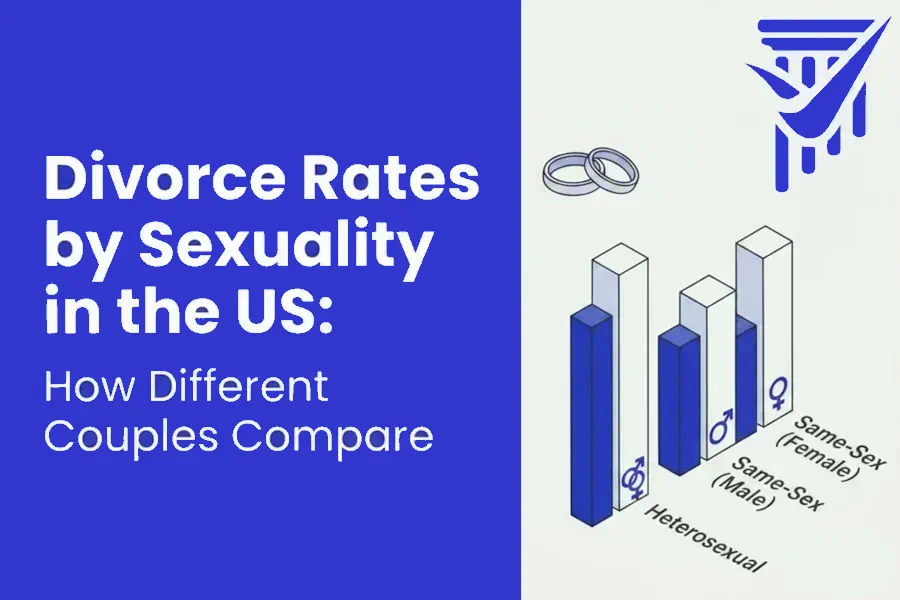
The lesbian divorce rates by sexuality are about 2-3x higher than gay male and 1.5-2x heterosexual couples’ divorces. The reason for this is usually more about gender dynamics, stress, and timing than relationship quality.
However, these statistics do not reflect the strength or bond of a relationship based on sexuality.
Same-sex marriage became legally recognized nationwide after the landmark Obergefell v. Hodges ruling in 2015. As a result, data on same-sex divorce is still relatively limited compared to decades of heterosexual divorce rate and marriage statistics.
This article leverages the available data to compare the divorce patterns of heterosexual, gay male, bisexual, and lesbian couples in the United States.
However, you should remember that this data reflects broader societal trends and should not be used to predict the fate of your marriage.
Divorce Rates by Sexuality: What the US Data Actually Shows
In the United States, 40-50% of heterosexual marriages end in divorce over time. On the other hand, same sex marriages show lower annual divorce rates around 1.1%, with major differences between the lesbian and gay male couples.
To understand these data, we’ll look at the numbers from major health and demographic institutions, including the Scandinavian studies, the US Census Bureau, the Centers for Disease Control and Prevention (CDC), and the Williams Institute at the UCLA School of Law.
The commonly mentioned numbers for divorce rates in heterosexual marriages by these institutions are between 40-50% over a lifetime, especially for first marriages. According to current annual divorce data, the United States has about 2.3 divorces per thousand people each year.
In contrast, however, the Williams Institute estimated its numbers for the annual divorce rates between couples of the same sex to be around 1.1 percent.
It is very important to note the differences between annual and lifetime divorce rates. The annual divorce rate is the percentage of active marriages that end within a year, while the lifetime divorce rate is that of all marriages that will eventually end in divorce.
The table below briefly compares what percentage of gay marriages end in divorce to other divorce rates by sexuality, including lesbian, gay males, heterosexual, and bisexual couples:
| Relationship Type | Annual divorce rates (%) | Lifetime divorce rates (%) |
| Heterosexual Couples | 2.3 per 1000 people | 40-50 |
| All Same-Sex Couples | 1.1 | Still developing |
| Lesbian Couples | Higher (takes about 70% of the same sex divorce rate) | Still developing |
| Gay Male Couples | Lower (takes about 30% of same sex marriages) | Still developing |
As we’ve discussed earlier, we only have about 10 years’ worth of data on same-sex marriage. It is currently impossible to estimate their lifetime divorce rate accurately.
Why Lesbian Divorce Rates Are Higher Than Average
Lesbian divorce rates are higher mainly because of gender-based social interactions, relationship expectations, and different stress factors, not because same-sex relationships are known to be less stable.
When we break down the data gender by gender (male and female), we noticed a large difference.
In the UK, specifically from the UK’s Office for National Statistics, where longer research on this subject has been carried out, lesbian couples account for over 72% of same-sex divorces, whereas only about 56% of same-sex marriages have been recorded.
Similarly, in the United States, female same-sex couples divorce up to 2.5 times more than male same-sex couples.
It is important to note that these are the divorce rates by gender, and they do not indicate that lesbian marriages are flawed or less loving than other marriages. Instead, researchers and sociologists have suggested that the gap is due to a specific set of researched factors.
By explaining these factors through psychology, economics, and gender sociology, we can finally see why female couples are statistically known to end their relationship.
Gender Dynamics Matter: Women Initiate Divorce More Often
According to research studies, including those led by the American Sociological Association, women have been observed to initiate over 70 percent of all divorces. This also applies to heterosexual marriages, where women are historically known to file for divorce when the relationship breaks down.
When you apply the same reality to same-sex marriages, you will find out that the statistics on lesbian divorces are true and reasonable. This is because, in a lesbian marriage, both partners belong to the same demographic (women), where there’s a higher chance of them initiating a divorce.
When the relationship between two women starts to break down, the likelihood that one of them will take the initiative to dissolve the marriage doubles.
This is why it is important to clarify that the higher divorce rates by sexuality in lesbians are linked to women as a group and how they deal with dissatisfaction in their relationships, not whether the relationship is straight or same-sex.
Emotional Expectations, Conflict Patterns, and Relationship Strain
Apart from women being prone to initiate a divorce, the behavioral and psychological layers of female relationships are also very important.
Research by sociologists suggests that women place a high value on three aspects:
- Emotional connection;
- Communication;
- Psychological intimacy in romantic relationships.
When these expectations are not met, they quickly lose interest in the relationship. Because two women in a romantic relationship usually share these values and expectations, any miscommunication or drop in intimacy level is greatly felt by both of them.
This could constantly lead to conflict between both of them and eventually a breakup because women are less willing to tolerate being miserable in a relationship than men.
Modern research and studies of cultural patterns indicate that differences in emotion, communication, and relationship breakdown are the primary reasons for separation.
So, it’s not that lesbian couples experience more conflict than other couples, but the fact that women in a romantic relationship cannot withstand any form of emotional stress for long before choosing to separate.
Minority Stress, Social Pressure, and Financial Stressors
Stress adds pressure to any type of relationship. Since marriage exists only in life, it can be affected by everyday stress and other external factors.
The minority stress model is a researched and well-documented framework that explains in detail how discrimination and stigma from society affect people while they go through their daily life activities.
For lesbian couples in particular, external stress such as pressure and rejection from family members, being treated differently in your workplace because you’re lesbian, and not being accepted by society in general, strains the relationship every day.
When couples have to defend their relationship to society amid other issues, problems develop gradually and, over time, become major issues.
In addition to stress, there are also financial problems. Because of the pay gap, women, on average, earn less than men. In a lesbian marriage, this affects the family financially because there are now two women earning less, and this negatively impacts their combined income.
A low combined income is known to increase financial stress, one of the top reasons for divorce across all demographics.
Why Gay Male Divorce Rates Tend to Be Lower
Gay divorce rate is the lowest, and this is usually influenced by lower divorce initiation rates, higher average income, and more selective entry into marriage.
To balance the comparison between lesbian and gay male divorce rates, it is important that we look at gay male couples, who only make up about 28% of same-sex divorces.
There are three potential reasons:
- Gender factors. The reason why they have a lower rate is that the factors affecting lesbian couples are the complete opposite in a gay male relationship, making the marriage equality between gay and lesbian a mirage. Men are known to initiate divorce way less than women. Hence, in a marriage between two men, the probability that one of them would initiate a divorce is known to be statistically lower.
- Financial capability. The combined income of two males in a relationship is usually higher than the normal gap, and this positively affects the family’s welfare in general. Higher income reduces financial worry and lowers the risk of divorce.
- Self-establishment. In addition, research made by sociologists suggests that gay male couples delay their marriages more than other demographics because they take their time to establish their lives and careers before settling down with their partner. This leads to a more stable and lasting relationship.
However, it is important that having a lower marriage dissolution rate does not automatically mean happiness in the relationship.
What it means is that the factors explained above help to significantly reduce the risk of gay male divorce.
What We Know About Bisexual Divorce Rates – And What the Data Misses
Data on bisexual divorce rates is limited because individuals are categorized based on their partner’s gender, which makes direct comparisons difficult. In the full spectrum of sexuality, bisexual people are a challenge for statisticians to study.
This is because, in every available data, bisexual individuals are usually grouped into either heterosexual or same-sex categories depending on who they are married to at the time.
Because there’s no specific data on bisexual marriages and no way to track them statistically, comparing them directly with other couples in the spectrum is impossible.
However, research suggests that bisexual couples face other challenges that can cause problems in their marriage. A common challenge is identity invalidation, which develops when the bisexual partner feels as though their bisexuality is ignored.
In addition, they also experience biphobia from heterosexual individuals and other people in the LGBTQ+ community, which often leads to them feeling isolated.
With the limitations of the current data, it is practically impossible to measure the rates of bisexual divorce.
How Obergefell Changed Same-Sex Marriage and Divorce Data
Since same-sex marriage became legal in the United States in 2015, current divorce data covers only a short period, from 2015 to 2025. It includes a backlog of long-term couples entering marriage simultaneously.
To understand any statistics on same-sex divorce, we have to include the context of the Obergefell v. Hodges Supreme Court decision, which led to the legalization of same-sex marriage in the United States in 2015.
After the court ruling, marriages increased across the country. Thousands of same-sex couples who had been committed to a long-term relationship rushed to get married since it is now legally possible. Within a short period of time, many of these couples divorced because they felt they had been together for so long.
This created a backlog effect, leading to a very high divorce rate in 2015. It was around 2020 that the data became stable.
The data collected from 2023 to 2025 is now more reliable to use, but not suitable for comparison with decades of data on heterosexual marriages.
Why Pre-2015 Comparisons Are Incomplete
Same-sex marriage was not legally recognized in the United States until 2015. The couples who were in long-term, committed relationships, at the time, were without legal marriage status. As a result, they were not included in the official marriage or divorce statistics that can be used for comparison.
This makes it difficult to find a consistent, standardized national data set to track these relationships. While some states recognized the marriage, others did not, and reporting methods varied widely, making the data collected before 2015 fragmented and incomplete.
Hence, this lack of recognition and consistency makes long-term comparisons of same-sex marriage with heterosexual couples unreliable and more prone to misinterpretation.
Heterosexual marriage data spans decades under stable legal frameworks, while same-sex marriage data only became fully measurable nationwide after legalization in 2015.
Why 2015-2025 Trends Need Careful Interpretation
You need to be cautious when interpreting divorce trends from 2015 to 2025. This is particularly important if you’re going through the data of same-sex couples because of the instability of the early data caused by the backlog effect immediately after legalization.
The data shows that many long-term couples got married at once, leading to a spike in both marriages and divorces in the statistics.
Now, there are signs of stabilization in the data, and the divorce rates by sexuality are beginning to look more like relationship patterns rather than the one-time surges in the stats.
However, these trends are still relatively new, meaning long-term patterns are still forming and may change as more data becomes available.
Hence, it can be misleading to do comparisons with heterosexual couples whose data spans decades, while same-sex marriage data covers a much shorter timeframe. This makes direct comparisons less reliable without context.
Which Factors Affect Divorce Rates Across All Couples
There are many risk factors that contribute to divorce aside from sexual orientation. Some of these may be a surprise to you, while others are obvious and actually understandable. Here’s a full breakdown of the factors that contribute to divorce among couples.
- Age. Most people who marry younger lack the maturity to fully comprehend what they’re signing on to because of limited life experience. How you view a relationship as a teenager tends to change as you grow older.
- Income and education levels. It is estimated that finances and educational levels are some of the leading causes of divorce, with 20-40% of all divorces resulting from the financial crisis. However, relationships with higher earnings and educational accomplishments are often more stable.
- Cohabitation. Several marriages hit rock bottom because the partners fairly know each other. As a result, living together before marriage for a longer time often helps partners to better understand themselves and their compatibility.
- Children. The presence of children can help enhance relationship stability and commitment to resolving marital conflicts. However, it can also introduce financial and emotional stress that may lead to divorce.
- Communication. Communication breakdown in marriages typically leads to conflict escalation that mostly results in divorce. Couples who communicate effectively are more likely to manage conflict well, have a smooth domestic partnership, and stay together.
- Social support networks. The people you surround yourself with during a relationship crisis often impact its longevity. This includes family, friends, coworkers, and now social media content you feed on.
Factors like cohabitation, income, and communication typically contribute to divorce rates more than others. A marriage can still be saved if both partners learn to share their thoughts.
How to Interpret Divorce Rates – And What They Mean for You
The divorce statistics show patterns and trends that have been consistent in marriages for a few years. However, you are the architect of your relationship; the outcome depends on your situation, decisions, and the path you choose from here on out.
The percentages reflect averages and not your personal predictions, so they shouldn’t be seen as what is fixed to be the outcome for any relationship.
You also need to understand that sexuality is not the only determinant of divorce outcomes. Risk factors like age, income, educational levels, communication, and conflict resolution are more crucial drivers of divorce compared to the group-based statistics.
In other words, individual circumstances matter far more than averages. However, if you are already considering divorce, the process itself becomes important.
Many couples choose an uncontested divorce, which is the most common and efficient option when both parties agree. Costs typically range from $300 to $5,000, depending on the complexity.
However, the legal process remains the same regardless of sexual orientation. Using a structured online process like YourForms can simplify paperwork by providing a structured, accessible approach that reduces time, cost, and complexity.