Navigating divorce often brings the question: how long does a divorce take? The answer, while varied, is crucial for planning. The timing of divorces is predictable, ranging from several months to years, depending on the type of divorce and the state in which it is being processed.
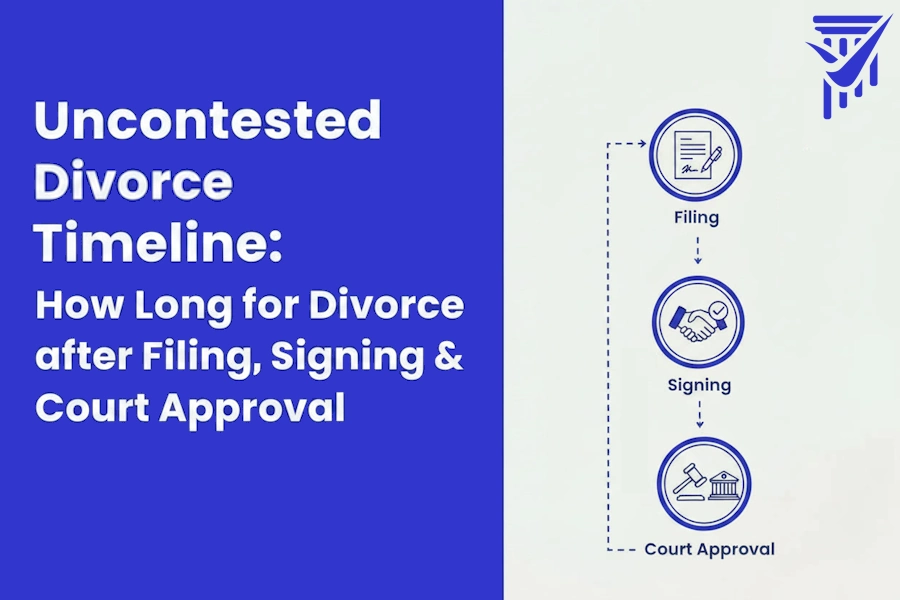
An uncontested divorce can be finalized within 2 to 6 months, but all divorces must adhere to minimum mandatory waiting periods.
Although state-mandated waiting periods are set, being able to agree with your spouse and providing accurate documentation significantly impact how fast can you get a divorce.
Quick Answer: Typical Divorce Timelines in the US
The time it takes for a divorce to be finalised in the US is usually between 2-18 months. Uncontested divorces can be concluded in 2-6 months, while contested divorces can take up to 12-18 months or even longer due to factors such as disagreements, court backlogs, and state waiting periods.
Most divorces in the US are finalized between 2 and 18 months. If both parties agree, a quick uncontested divorce can be arranged – usually within 2 to 6 months.
Contested divorces involving disputes over property or child care can take 12 to 18 months to settle – or much longer in complicated cases.
All states have minimum wait times ranging from 0 to 6 months before you can file for divorce, including amicable cases. The date of filing does not mark the end of divorce proceedings, which can only be finalized after all legal requirements, including the waiting period have been met.
Accurate documentation is essential to avoid any delays in processing your divorce application.
How Long Does a Divorce Take by Case Type?
The type of divorce affects how long it takes. Every type of divorce case comes with a unique timeframe for divorce proceedings that are dependent on both spouse agreements and the legal actions taken.
Below is a summary of typical timelines and key drivers:
| Divorce Type | Typical Timeline | Key Drivers |
| Uncontested (no children) | 2-4 months | Mutual agreement, minimal court, state waiting period. |
| Uncontested (with children) | 3-6 months | Mutual agreement, child plans, state waiting period. |
| Mediated Divorce | 4-8 months | Mediator helps reach agreements, less court time. |
| Contested Divorce | 12-18 months | Disputes (property, custody, support), discovery, hearings. |
| High-Conflict Divorce | 18-36+ months | Extensive disputes, multiple court interventions, potential trial. |
More differences between spouses can lead to longer divorce procedures. Disputes over child custody and finances contribute significantly to the prolongation of the divorce process.
Mediation can lead to shorter divorce timelines compared to going to court in a contested divorce case.
Opting for an uncontested divorce procedure is generally the quickest way to complete a divorce.
Uncontested Divorce Timeline
An uncontested divorce occurs when spouses agree on all details – property division, child care and financial assistance. Mutual agreement allows for a faster process, which depends on state-imposed waiting periods and court procedures.
Most uncontested divorces are finalized within 2 to 6 months, depending on state laws with little or no need for court appearances. It’s the fastest path to get a divorce, and understanding how long does an uncontested divorce take is key.
Properly prepared legal documents at the beginning of the process help avoid delays.
Contested Divorce Timeline
A contested divorce occurs when couples cannot agree on important matters resulting in a lengthy multi-stage legal process that extends the length of the divorce.
This includes a discovery phase (2-6 months) to share financial information and followed by court appearances and negotiations (3-9 months).
If there is no agreement, increased preparation work and time are required prior to going to trial.
A contested divorce generally takes 12 to 18 months; however, complex issues such as substantial assets or child care matters can lead to divorces taking longer than 24 months.
The prolonged conflict in a contested divorce carries substantial financial and emotional costs.
Default Divorce Timeline
A default divorce occurs when one spouse files for it, and the other party doesn’t respond within the time limits set by law.
The process starts with the spouse who initiates divorce proceedings making sure that all necessary steps of serving notice (service of process) are completed properly.
If no response is received after a period of 20-30 days, a request can be made for a default judgement.
Following the default divorce timeline, the case can be resolved in 2 to 6 months provided there are no inter-state issues to consider. Delays may occur if service of process is not done correctly or if the court needs more information.
State Waiting Periods That Can Make or Break Your Timeline
A critical factor in how long does a divorce take is the state-mandated waiting period, a legally required duration between filing and finalization.
The required “cooling-off” periods range from 0 days to 6 months and are different from the separation requirements (living “separate and apart” for a specific period of time – usually 6 months to 1 year – to prove that your marriage has broken down).
Even if you have a friendly uncontested divorce, you will need to observe the minimum waiting period. Residency requirements also affect the ability to file for divorce. Understanding both of them is important in determining how long does it take to get divorced.
Here’s a table outlining the required waiting periods and residency requirements in different states to provide better clarity about the shortest possible divorce duration in your state of residence:
| State | Residency Requirement | Waiting Period* |
|---|---|---|
| Alaska | If in Alaska when filing and intend to stay, or if spouse is resident | 30 days |
| California | 6 months in state, 3 months in county for one spouse | 6 months |
| Florida | 6 months for one spouse | 20 days |
| Illinois | 90 days for one spouse | None |
| New York | 1 year (lived together in NY); 2 years (did not live together in NY) | None |
| North Carolina | 6 months for one spouse. 1 year and 1 day separation required before filing | None |
| South Dakota | None, but must be resident during proceedings | 60 days |
| Texas | 6 months in state, 3 months in county for one spouse | 60 days |
| Washington, D.C. | 6 months (uncontested); 1 year (contested) | None |
*Note: Some states have no mandatory waiting period after filing, but the actual processing time by the court can still introduce a delay.
Fastest States for Divorce
For those seeking how fast can you get a divorce, states like Florida, Illinois, and Washington, D.C. have minimal or no mandatory waiting periods.
Although an uncontested divorce can be finalized within weeks, court proceedings and accurate documentation mean that quick divorces are rare.
State residency rules still apply. These states offer the quickest route to obtaining an uncontested divorce providing all conditions are met.
States With the Longest Divorce Timelines
However, some states have longer divorce timelines due to lengthy waiting periods or separation requirements. California has a 6-month waiting period from the date of service.
North Carolina requires a one-year and one-day separation period prior to filing for divorce. States with heavy court caseloads such as New York and New Jersey contribute to longer divorce timelines due to administrative delays.
Note that legal delays (waiting periods) and court delays (administrative bottlenecks) are two different things.
The combination of lengthy waiting periods and unresolved disputes can extend the duration of the divorce process, particularly in a contested divorce.
What Delays a Divorce the Most?
Most divorce delays are caused by disagreements, court backlogs and incomplete paperwork rather than the legal process itself.
Although state waiting periods set a minimum divorce timeline, major delays in obtaining a divorce are caused by things that can be controlled.
Understanding the obstacles involved with getting a divorce will help you deal with this process effectively:
- Contested Issues: Disagreements over child custody, support, and property division are major delay causes. Each unresolved conflict adds months, requiring negotiations, mediation, or court intervention. More contested issues prolong the time to finalize a divorce.
- Court Backlog: The administrative inefficiencies in court of local authorities may result in delays from 3 to 12 months in scheduling and decrees, regardless of the level of cooperation.
- Service of Process Delays: Difficulty serving your spouse with divorce papers or intentionally avoiding them can extend the initial stage significantly.
- Custody Disputes: Disputes about childcare are complicated and time-consuming, and they may involve evaluations (2-4 months) and numerous court hearings.
- Financial Complexity: Divorces with significant or hidden assets require thorough financial investigation work, with an additional 1-3 months required to investigate each type of asset.
- Discovery Process: In contested cases, the discovery process – exchanging information and evidence – can take an additional 2 to 6 months.
- Paperwork Errors: Incomplete or incorrect documentation leads to avoidable delays. Simple mistakes result in requests for corrections and re-filing, causing delays of 30 to 60 days with each cycle of corrections leading to a longer wait period for obtaining divorce.
These factors collectively determine how long does it take to finalize a divorce.
The Divorce Process Timeline: From Filing to Final Decree
The divorce process timeline includes several important steps, with uncontested divorces being able to skip out on several time consuming parts of a contested divorce.
- Filing the Petition (Day 1): The petitioner files for divorce, outlining initial proposals.
- Serving the Spouse (1-30 days): The respondent is legally notified via service of process.
- Response Period (20-30 days): The respondent files a formal reply. No response can lead to a default judgment.
- Discovery (if contested) (2-12 months): In contested cases, parties provide financial and any other relevant information.
- Mediation (1-3 months): A neutral mediator helps the couple come to an agreement, reducing the time needed to obtain a divorce and making the process of divorce easier.
- Settlement or Trial (1-6 months): If mediation succeeds, a settlement is drafted. Otherwise, the case may proceed to trial, potentially requiring a trial date.
- Final Decree: The judge signs the final decree, legally ending the marriage, subject to any state-mandated waiting period (a mandatory cooling off period).
The timeframe for an uncontested divorce is shorter because it typically bypasses steps such as discovery, mediation and trial, and proceeds straight to the final decree after allowing for the requisite waiting period.
This demonstrates how fast can you get a divorce with cooperation.
How to Finalize a Divorce Faster With Fewer Delays

The quickest way to resolve a divorce is to file an uncontested case with complete and accurate documentation and avoid unnecessary court involvement.
Here’s how fast can you get a divorce:
- Agree on All Terms Before Filing: Having reached comprehensive agreements on matters of property division, child custody and support prior to filing can change a contested divorce into an uncontested one, allowing you to complete the divorce proceedings much faster.
- Choose Uncontested Divorce: This path avoids lengthy discovery and trial processes, with the majority of the uncontested divorce timeline consisting of state waiting periods and administrative processing.
- Prepare Documents Correctly: Inaccurate paperwork causes delays (30-60 days per correction). Meticulously preparing legal documents, ideally with services like YourForms, ensures accuracy from the start. Transparent flat-rate divorce packages help you budget the process upfront without surprise legal fees.
- Use Waiver of Service: A cooperative spouse can sign a Waiver of Service, avoiding delays from formal service of process.
- Organize Financial Documents: Actively collecting financial data enables prompt financial disclosures and avoids delays in the process of dividing assets.
- Avoid Court with Mediation: Even with disagreements, mediation can facilitate agreements, shortening the divorce process timeline compared to litigation.
Prioritizing agreement, good preparation and making use of resources such as YourForms that provide state specific legal documents can help to reduce the amount of time needed to complete the process of getting a divorce and achieve a more predictable divorce timeline.