

California Uncontested Divorce Online
An agreement on the terms of your separation can allow you to pursue a divorce in California. The settlement should cover assets, debts, spousal support, and any child custody issues. Couples who meet requirements may qualify for summary dissolution, a simpler process with fewer forms.
You do not have to hire an attorney to draft your divorce paperwork. With YourForms, you can prepare the documents for your California divorce online from home, at your own pace. We provide forms and filing instructions to help you work through the required steps.
Choose a plan based on the guidance you need. Court fees are paid separately.
What is an Uncontested Divorce?
In an agreed divorce, spouses settle all terms without asking a judge to resolve their disagreements. Their written settlement covers assets and debts, any alimony arrangements between spouses, and, where applicable, child custody, parenting time, and each parent’s financial responsibilities.
“Uncontested” describes how the case is resolved. It does not identify one specific court procedure. Spouses can settle a California divorce before any papers are filed or while the case is underway.
Key Differences between Summary Dissolution, Joint Petition, and General Dissolution
- Summary dissolution: A simplified process for couples who meet strict eligibility rules, including limits on marriage length, assets, and debts. Couples must have no children together, and neither spouse may be pregnant. Both spouses sign Joint Petition for Summary Dissolution (FL-800) and permanently waive alimony.
- Joint petition: Available since January 1, 2026, this option uses Joint Petition for Divorce (FL-700) and Summons—Joint Petition (FL-710). Spouses submit the forms together and must agree on all final terms, including child custody and assets, although they can work out details after the papers are filed. Children and substantial assets do not automatically exclude them.
- General dissolution: One spouse files CA divorce forms, including Petition—Marriage/Domestic Partnership (FL-100) and Summons (FL-110), then arranges service on the other party. The spouses can resolve the case by settlement.
Do You Qualify for an Online Uncontested Divorce in California?

YourForms prepares paperwork for spouses who have agreed on all divorce terms, including cases involving children, assets, or shared debt. Before filing for divorce in California, check which court procedure fits your situation. Agreement on all issues does not automatically make you eligible for the simplified FL-800 procedure.
| Legal Feature | Summary Dissolution (Simplified) | General Uncontested Dissolution |
|---|---|---|
| Marriage/Partnership Duration | Five years or less at separation | Any duration |
| Minor Children & Pregnancy | No children together; neither spouse pregnant | Children and pregnancy do not automatically disqualify you; if minor children are involved, FL-105 is required. |
| Real Estate Ownership | No ownership; residential lease must end within one year of filing and have no purchase option | Ownership allowed; agreement addresses division |
| Property & Debt Limits | Net community property under $57,000; each spouse’s net separate property no more than $57,000; marital debts no more than $7,000. Excludes cars and car loans | No eligibility caps on property or debt |
| Spousal Support Waiver | Both permanently waive support | Agreement may provide for support; FL-343 can record the terms |
| Primary Required Forms | Joint Petition (FL-800); Judgment (FL-825); exchange FL-150 and financial worksheets or disclosure forms | Petition (FL-100), Summons (FL-110), and Judgment (FL-180); exchange FL-140, FL-150, and FL-142 or FL-160; file FL-141 |
Your California divorce papers must also address any applicable child custody and child support orders. The table compares the simplified FL-800 procedure with the standard FL-100 route; the separate option described above starts with FL-700 and FL-710.
YourForms Service Tiers
When choosing a DIY approach, utilizing a guided service ensures everything is filled out accurately. The following YourForms service tiers offer transparent support for preparing court-ready forms.
Understanding Divorce Requirements: Residency and No-Fault Grounds

State (6 Months) and County (3 Months) Residency Rules
Before filing for divorce in CA, you or your spouse must have been residents of the state for 6 months or more and residents of the county where you file for divorce for 3 months or more. Exemptions from these requirements are California-registered domestic partnerships and some same-sex couples who were married in California.
No-Fault Grounds: Irreconcilable Differences and Incurable Insanity
Neither party is required to prove any misconduct in order to obtain a divorce. California law recognizes the grounds of “irreconcilable differences” (i.e. certain problems that cannot be fixed and which cause the marriage to break down).
The other ground, permanent legal incapacity to make decisions, requires proof that includes medical or psychiatric testimony. “Incurable insanity” is outdated terminology.
The Mandatory 6-Month Waiting Period from Date of Service
Filing divorce papers in California does not start the waiting period in a regular case. The six months run from service of the summons and petition or the respondent’s court appearance, whichever comes first.
For proceedings started jointly using FL-700 or FL-800, the period starts when you file. Your marriage does not end automatically when six months pass; the court must enter a judgment, and its stated termination date controls.
How to File for Divorce in California: Step-by-Step Process

These steps explain how to file for divorce in California by yourself through the regular petition process. Joint petitions and summary dissolution follow different procedures.
- Step 1
File the Petition (FL-100), Summons (FL-110), and Local County Forms
Complete Petition—Marriage/Domestic Partnership (FL-100) and Summons (FL-110). Add FL-105 if you have minor children together. Check your county’s requirements: Los Angeles requires its Family Law Case Cover Sheet (FAM 020).
Check whether you can file for divorce online. California counties have different e-filing procedures. Otherwise, submit the documents in person or by mail. Keep copies stamped by the court.
- Step 2
Serve Your Spouse Personally or by Mail with FL-117
Choose a server who is at least 18 and not a party to the case. You cannot serve the papers yourself. Give your server copies of the filed documents and a blank Response (FL-120).
The server can hand the papers directly to your spouse or mail them with Notice and Acknowledgment of Receipt (FL-117). To complete this method of service, your spouse must sign and return the acknowledgment. The server completes FL-115; file it with the signed FL-117 attached when applicable.
- Step 3
Exchange Preliminary Financial Disclosures (FL-140, FL-150, FL-142/FL-160)
Gather tax returns, recent pay stubs, and records of assets and debts. Prepare:
- Declaration of Disclosure (FL-140).
- Income and Expense Declaration (FL-150).
- Schedule of Assets and Debts (FL-142) or Property Declaration (FL-160).
Have the paperwork served on your spouse. To finalize the divorce by agreement, both spouses must exchange preliminary disclosures, even if one does not file a response. You generally have 60 days after filing FL-100 to serve these disclosures; a responding spouse generally has 60 days after they file FL-120.
File Declaration Regarding Service of Declaration of Disclosure (FL-141). The disclosure packet is exchanged privately, although FL-150 may need to be filed separately depending on the orders requested.
- Step 4
Submit an Agreed Judgment or Request Default
If a response was filed and you reached a settlement, submit it with FL-130, Declaration for Default or Uncontested Dissolution or Legal Separation (FL-170), Judgment (FL-180), and Notice of Entry of Judgment (FL-190).
If at least 30 days have passed since your spouse received the papers and no response has been filed, you may request default using FL-165. A default with agreement also requires the respondent’s notarized signature on the settlement. You must still submit the required judgment packet.
Review FL-182 before you submit your divorce forms. California requirements include additional attachments for child custody and support orders. Ensure all required forms are included before submitting your packet.
Address any corrections the court requests. Once the judge signs the judgment, keep the filed copy and check the date your marriage legally ends.
Navigating Specific California Divorce Forms: Financial Disclosure, Fee Waiver, and E-Filing
YourForms provides document preparation and instructions for submitting your paperwork. Some documents must be filed with the clerk; others go only to your spouse. Preparing for a CA divorce online does not change those requirements.
Mandatory Financial Disclosure Packet and Final Disclosure Waiver (FL-144)
The preliminary packet described above gives each spouse a record of the other’s income, expenses, assets, and debts. Check that your forms include the required supporting records, such as tax returns and proof of income.
Spouses cannot agree to skip preliminary disclosures. They may waive final disclosures by signing and submitting Stipulation and Waiver of Final Declaration of Disclosure (FL-144). Both must satisfy the form’s conditions, including exchanging preliminary information and updating material financial details. A waiver does not excuse hiding assets or income.
What If You Cannot Afford Court Fees? (FW-001 & FW-003 Fee Waiver Requests)
You may qualify for a fee waiver if you receive qualifying public benefits, meet the household income limit, or cannot pay the required fees while meeting your household’s basic needs.
Complete Request to Waive Court Fees (FW-001) and item 1 of Order on Court Fee Waiver (FW-003). File them when fees are due. The clerk or judge records the decision on FW-003. Your request is confidential.
E-Filing Options Through Court-Approved Providers
Check your county’s family law page before you upload your divorce papers. California counties have different e-filing rules and document exclusions. Orange County, for example, excludes judgments from family law e-filing.
Where available, choose a provider listed by your court. Follow its instructions for file format, signatures, and payment. An upload alone does not establish that your papers were accepted; check for confirmation and retain the filed copies.
Why Choose YourForms for Your California Online Divorce?
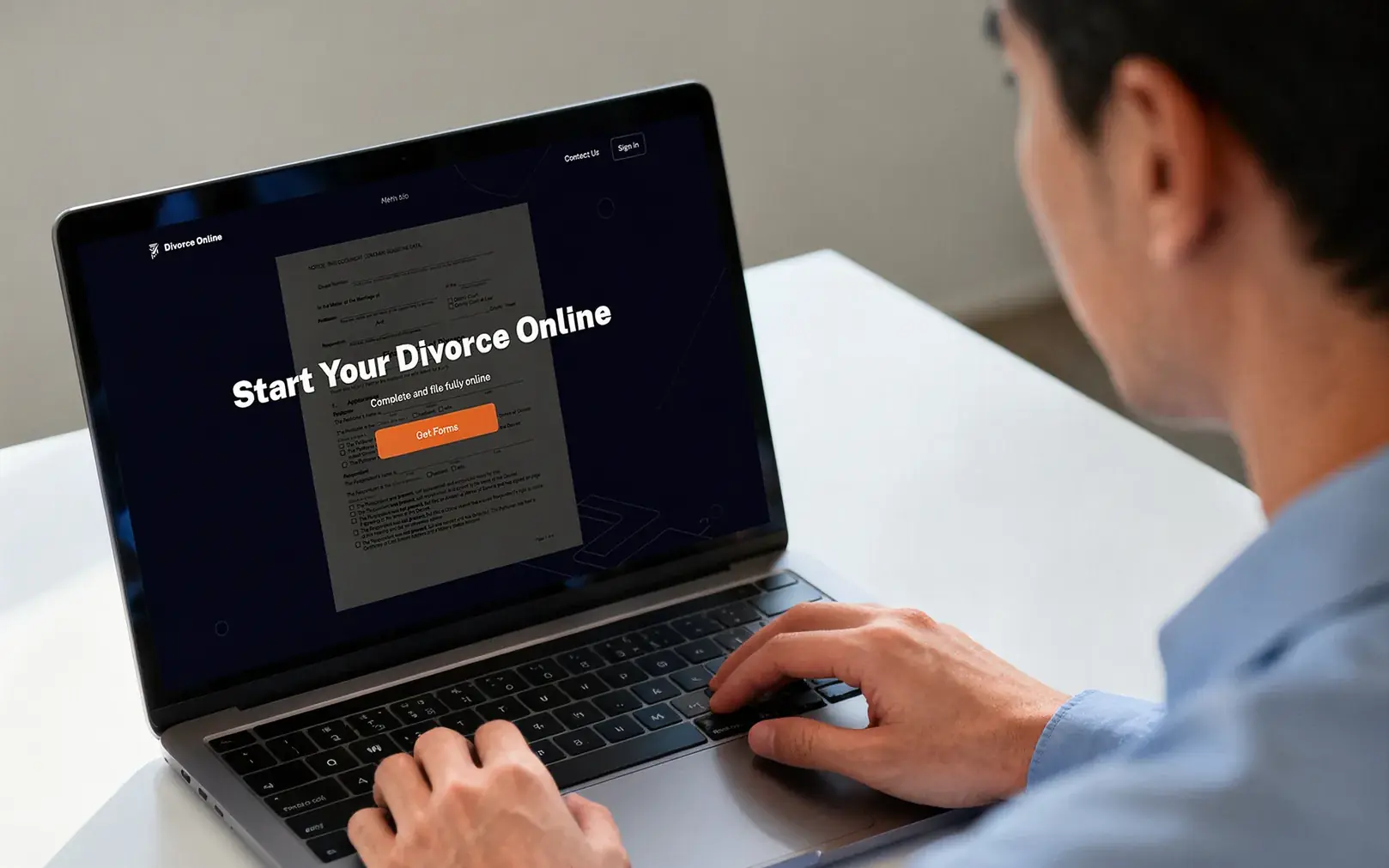
YourForms helps you prepare the paperwork for your divorce online. California forms are completed from the information you provide about your family, assets, and agreement. Our plans include submission instructions, with Case Manager review under Full Support.
| Aspect | Traditional Attorney | YourForms Online Divorce |
|---|---|---|
| Total Average Expense | $3,500 – $8,000+ | $928–$1188+ Final costs depend on the length of time your case remains active.* |
| Document Preparation Time | Depends on the attorney’s schedule and case details | Completed online in a few hours |
| E-Filing Portal Support | Depends on the services included in your settlement | Court instructions provided; availability and accepted documents depend on your county |
| Form Accuracy & Completeness | Attorney prepares and reviews forms within the agreed scope | Forms prepared from your answers; Full Support includes Case Manager review. Court acceptance is not guaranteed |
*Illustrative estimate, not a measured average: seven to twelve months with Basic Plan ($69 setup + $69/mo) or Full Support ($199 setup + $49 from month two), plus one $435–$450 fee payable to the clerk. A Response or joint petition changes the total fees due. Postage, fees for delivering papers to the other party, and portal charges may add costs. Seven/twelve months is a budgeting assumption, not a required subscription term.
How YourForms Works: Step-by-Step Process
 STEP 01
Answer the questions
Provide details about your children, assets, and agreed terms.
 STEP 02
Review your forms
Check the information and make any needed edits.
 STEP 03
Follow the instructions
Add the required signatures and submit your completed packet to your court.
Key Divorce Rules: Costs, Timeline, and Laws
How Much Does a Divorce Cost?
Your costs depend on how you file for divorce. California agreed cases are estimated at $435–$8,000, depending on whether you handle preparation yourself, use an online platform, or hire an attorney. Estimated costs rise to $5,000–$12,000 for mediation and $10,000–$50,000+ for contested cases.
 Related article: Divorce Cost in California
How Long Does an Agreed Divorce Take?
Even with forms prepared for divorce online, CA residents must meet the six-month waiting period. Court review can extend the process. Our California divorce timeline explains when the clock starts and what can cause delays.
Divorce Laws, Grounds, and Community Property Rules
California allows no-fault divorce. Community property and debts are generally divided equally unless spouses agree otherwise. A judge must approve the final orders.