No disputes between you and your spouse? Then, online dissolution of the marriage with YourForms is a faster and cheaper solution.
How to file for divorce without a lawyer with its help in the USA? You get our questionnaire refilled, our service provides you with the necessary forms, you complete them and file for divorce yourself.
The most realistic case is when you apply for an uncontested divorce without a lawyer. Although it’s the simplest breakup, you still have to meet your state and county rules.
YourForms here is a structured service that delivers the appropriate forms and provides clear filing instructions. We’re a guided self-help tool, not a legal adviser or representative.
How to run a DIY divorce online? What’s the cost? Which nuances and possible mistakes may result in delay or turn your almost settled proceedings into a risky case?
This page explains uncontested divorces online from A to Z. Join to get all your questions answered.
Quick Answer: Can You File for Divorce Without a Lawyer?
Let’s get straight to the point. Can you get divorced without a lawyer by filing for it yourself? Yes, you can. If you’ve prepared for an uncontested divorce, YourForms can help you with forms and further filing steps.
Here are the key things to remember before starting:
- You may expect a favorable decision if your case has no disputes, your spouse is cooperating, and you use the correct forms accepted in your region.
- No-lawyer proceedings are possible, but there’s no divorce without a court!
- Even a simple case involves preparative actions in strict compliance with your local laws.
- You’ll have to serve papers correctly, submit the final documents, and pay court fees, including filing fees. You might need to handle notarization, copies, and any parenting requirements, and wait as long as required.
- The cost of an uncontested divorce without a lawyer ranges from $300 to $ 1,500, as opposed to lawyer-led cases, which usually cost $7,000–$15,000 or even more if an attorney’s services are necessary.
You may start with YourForms for $69/month if your situation is simple. The service is available in most US states and provides court forms and instructions in accordance with the rules of the requested region.
When a No-Lawyer Divorce Is Usually Possible
Let’s define the situations in which a petitioner has every chance to successfully complete a breakup process without legal representation. Here’s a list of the cases with the highest chances of approval in court:
- Both spouses consent to divorce.
- They achieved an agreement on everything that matters in the case.
- The spouse’s location is known.
- There’s no coercion, hidden aspects, or safety concerns.
- The applicant feels confident with court paperwork and filing instructions.
If your case corresponds to all these statements, YourForms can be helpful. It has state-specific court forms for uncontested divorces and all the necessary filing instructions.
What You Still Have to Do Yourself
YourForms is a handy tool reducing paperwork confusion. Still, you rule the process yourself and are responsible for:
- Accurate & genuine information.
- Papers reviewed before filing.
- Handling required signatures.
- Paying third-party commissions & court filing fees or applying for a fee waiver.
- Following procedures and court deadlines.
- Serving the spouse, attending a hearing, or submitting final judgment documents if required.
At YourForms, there’s a clear refund policy. However, you’re eligible for it only if an inner technical mistake occurs. Your own faults won’t be covered.
Where Online Divorce Forms Can Make the Process Easier
While selecting a proper blank court PDF for your uncontested divorce without lawyer representation, it’s easy to get confused. You have to pick the exact form for your state and county that fits your situation, including assets, debts, children, and the spouse’s response path. YourForms offers an easier track:
- YourForms asks case-specific questions online.
- You give detailed answers.
- YourForms helps you prepare divorce papers in compliance with your state/county requirements.
This tool is available on a subscription plan with a $69/month starting price. Be ready for 2-3 days of paper preparation before filing. We also offer add-ons, such as e-signature, online notarization, document delivery, and filing support, where available.
Is it a sound way for you? Initiate your guided divorce with YourForms today instead of looking through loads of court PDFs.
Do You Need a Lawyer to File for Divorce?
Will I attain the final divorce decree, or am I making a mistake? That’s the main doubt users have about the online DIY procedure. The answer is yes, and you’ll get it without a divorce lawyer if you’ve reached terms with your spouse and there are no disputes, so no full attorney involvement is needed.
If unexpected assets, safety concerns, or property complications arise, you might need extra legal help. It’s often true for cases when your spouse already has a legal representative. Sometimes, to have a clearer view of your specifics, limited reviewing may be enough. If there are disputed points, seeking full legal assistance might be a safer path for you.
In this respect, YourForms is your trusted helper for paperwork preparation, not a legal solution. Use it if you know the further in-court procedure and are ready for all the proceedings. Do not expect that YourForms will solve a problematic case.
When You May Not Need Full Attorney Representation
Do you need a lawyer to file for a divorce? You may manage without full attorney representation if:
- You and your spouse are willing to sign and participate.
- There’s no hidden income.
- There are no complexities with tax, retirement, business, or real estate.
- Neither of you has custody, parenting schedules, or support claims.
- You agree to all major terms.
No attorney is required if your main problem is how to organize documents and file them correctly. This is where YourForms is more cost-controlled than attorney representation.
When Limited Legal Help May Be Enough
In some divorce cases, it’s important to settle the agreement correctly. There, asking a lawyer to review the paperwork or request minimum legal advice is more reasonable than using full attorney representation. Fall back upon this tactic if you need to review:
- Retirement account division.
- Support terms.
- Tax consequences.
- Property buyout.
Despite these complexities, you’re still filing an uncontested divorce? Then, limited-scope help is enough, and you may opt to use YourForms to prepare the documents.
When Hiring a Lawyer Is the Safer Move
Entrusting the job to a lawyer is more sensible when your agreement is incomplete or contains disputable points. Explore the most frequent triggers of friction:
- Contested custody/support.
- Hidden income/assets.
- Business ownership.
- Retirement plan with a separate order needed.
- Domestic abuse or coercion.
- Power disparity between spouses.
- Family home disputes.
- A lawyer already represents your spouse.
A money-saving approach in such cases may end up with even larger expenses in court. Never attempt to use online divorce tools for unfair paper management – it’ll never work, and you’ll lose your money and the case.
Before You Start: Is Your Divorce Truly Uncontested?
Now, the central question to answer: Is your divorce actually uncontested? It is, indeed, if the main points are settled between you and your spouse. That is, you may have children, property, assets, and even debt, and it doesn’t mean that your case is contested. If spouses agree on all terms like these, their divorce is processed as uncontested.
So, the key goal is to reach an agreement and confirm it in writing. This part has the strongest impact on the final cost and timeline in an uncontested divorce. If you have already achieved such an agreement, YourForm is a powerful tool that may turn it into a paperwork package ready for court examination.
Agreement on Property, Debt, and Support
For a no-delay, uncontested divorce without a lawyer, your agreement on marital property should be consistent and fair. Whether you divide real estate or debt, settle everything in strict accordance with the local laws.
The agreement should be clear on the home equity or business division. There should be no disputes about your retirement plans, loans, credit cards, etc. The more complex your assets are, the more likely you’ll need to consult a lawyer or a financial specialist. Neglecting details or relying on vague agreements is a sure path to long-term problems in court.
Agreement on Children, Custody, and Parenting Time
A divorce with children is not contested by default. You may also run it without a lawyer if the following agreements are made:
- Parents agree on custody and their roles in decision-making.
- Parenting times are settled.
- There’s a clear plan for weekdays, weekends, holidays, transportation, healthcare, and communication.
- Parents acknowledge the child support requirements and are ready for further guidelines.
Your child-related agreement will be reviewed in court, even if there are no disputes between you and your spouse.
Knowing Where Your Spouse Lives and Willingness to Cooperate
The legal procedure includes service on your spouse, the formal delivery of breakup papers. Their staying in touch and readiness to communicate are crucial for a fast, uncontested divorce. The most favorable case is when their location is known, and they collaborate.
Your spouse doesn’t answer? The case may go default, but proper service and final documents are required. The spouse’s residence and level of involvement are included in the YourForms questionnaire. Are you unaware of their actual location? Do they evade the process? Then, you might need extra legal help and go through additional court steps.
Red Flags That Can Turn a Simple Filing Into a Dispute
Do you need a lawyer to file for divorce? Yes is a meaningful answer in the following circumstances:
- Your spouse comes up with a new plan for signing.
- They dispute custody, support, debt, or property.
- They withhold financial data.
- They force you into unfair conditions.
- The agreement is uncertain regarding safety.
- They retained a lawyer.
These situations are not fatal. However, a no-lawyer divorce format isn’t the best way to solve them.
How to File for Divorce Without a Lawyer: Step-by-Step
Your agreement is certain, and you are ready to submit papers to the family court. Here’s how to file for divorce yourself:
- Confirm the eligible state & county to file your case.
- Select the correct divorce process.
- Fill out the right forms for your state & county.
- File the paperwork with the court and pay the filing fees of about $150–$450, depending on the region.
- Serve your spouse.
- Complete the necessary financial & parental proceedings.
- Submit final papers.
- Wait for the final divorce decree.
Engage YourForms in this process, and you won’t have to build the paperwork from scratch. Based on your questionnaire answers, YourForms can help you prepare state-specific documents without having to search for the correct court forms yourself.
Step 1. Confirm Residency and the Right Court
You have to meet the residency and venue rules while filing for divorce. These rules differ from state to state.
Thus, you may apply in California if you’ve lived for at least six months in the state and at least three months in the current county. Compare it with Colorado, where your residency should be 91 days or more. However, if you’re divorcing with kids, you may file only if they’ve lived since their birth or at least 182 days in Colorado.
What can go wrong: If you file too early, this may cause delays in court. So, check the state/county rules by examining the court/clerk instructions before filing.
Step 2. Choose the Correct Divorce Process for Your Case
Selecting the process type that corresponds to your case is essential. The options include:
- Uncontested.
- Default.
- Simplified or joint.
- Contested.
A simplified (joint) process is available for spouses who are ready to get divorced and settle all division terms out of court. It’s faster and cheaper, but it’s not supported by all states.
In California, your process options will include regular divorce, joint petition, and summary dissolution (or express divorce). In Texas, your case can be qualified as fault-based (contested; can be default or collaborative) or no-fault (uncontested).
What can go wrong: Applying for a simple divorce process while having minor children, significant property, or other complexities may cause delays.
YourForms stands out as a helpful tool for filing an uncontested divorce without a lawyer. You cannot take it as a universal solution for every breakup.
Step 3. Get the Right State Forms and County Divorce Forms
Pay thorough attention to the court forms you’re choosing. Every state has its own and provides its own specific instructions. There may also be county-based filing rules, e-filing requirements, cover sheets, or special demands made by the current judge.
If kids, complex assets, debts, etc., are involved, a different type of form is needed. Needing a fee waiver, specific service method, or a default path also matters.
What can go wrong: Using blank PDFs often leads to confusion and mistakes. The best way to select the correct filing forms is to use Your Forms. The instrument provides state-specific forms based on the answers you‘ve given in the questionnaire.
Step 4. Complete the Petition, Summons, and Required Disclosures
By submitting a petition, you ask the judge to divorce you and your spouse in a formal way. This document starts the process.
With the help of the summons, you inform your spouse that the divorce case has been initiated.
Even an uncontested divorce without a lawyer may require financial disclosures. Specific forms may be necessary depending on the case (e.g., minor children, pension division).
What can go wrong: At this stage, data accuracy should be your first priority. Mistakes in names, addresses, case type, kids, assets, or requested orders cause delay.
Step 5. File Your Divorce Papers With the Court
Divorce papers can be submitted in person, by mail, or online. The latter option is available in multiple courts, though not all.
If you submit in person, make sure to keep stamped copies and a filing confirmation. The fact that the clerk has accepted your papers for filing doesn’t mean the divorce is approved. Court filing starts the case, usually with a key response and a definition of waiting timelines.
What can go wrong: While using YourForms, you’ll have to cover the filing fee to the court via a separate service. You may pay it online, via mail, or in person, through the Clerk of Court registry.
Step 6: Pay the Filing Fee or Request a Fee Waiver
Depending on the state and county, court filing fees range from $150 to $450. You should check the exact sum locally. The king of fee variations is Texas. In this state, fees for filing, issuance, and service vary by county. There’s also the Statement of Inability option. That is, you may request a fee waiver if you cannot afford to pay. Still, its approval isn’t guaranteed.
What can go wrong: While running an uncontested divorce without a lawyer, make sure to cover the court fee or claim a waiver. Usually, YourForms pricing doesn’t cover the court filing fees. They’re included only if stated in the checkout or service terms.
Step 7. Serve Your Spouse or Use a Waiver of Service
Your act of legally notifying your spouse about the divorce case is called service. Some courts allow service waivers, and your spouse may sign one to speed up the process. If the option is unavailable, you can deliver the service by involving a sheriff, constable, private process server, certified mail, or another method supported. In Texas, only the first three options will be available to you, and proof of service should be filed.
What can go wrong: Do you have all the papers in order, but fail with the service formalities? This usually delays the issuance of the final decree.
Step 8. Wait for a Response, Agreement, or Default Path
The following events may follow the service:
- The spouse responds and signs the agreement.
- The spouse responds but rejects the final terms.
- The spouse doesn’t respond.
What can go wrong: If your spouse fails to respond, your case can be processed as a default divorce. However, the formal service and response periods will take extra time. If the spouse responds but declines the agreement, your case becomes contested. You’ll have to settle all disputes to get the process moving. So, it’s crucial not to assume that the spouse’s silence guarantees an instant divorce.
Step 9. Complete Parenting, Support, or Financial Requirements
How to file for divorce without a lawyer, with child support terms? Be ready to provide additional papers that concern children, property, and support if necessary:
| Divorce with: | Extra documents to file: |
| Children | Parenting plans;Child support worksheets;Insurance;Parenting courses;Extra court review. |
| Property | Financial disclosures;Settlement conditions;Asset/debt details. |
| Support | Written agreement terms;Support calculations. |
What can go wrong: Do not ignore procedures such as parenting courses. In Florida, for instance, Parent Education and Family Stabilization courses are DCF-approved and mandatory (minimum of 4 hours). Not to miss anything while filing through YourForms, provide all the details of your case in the questionnaire. This will help to identify the necessary documents.
Step 10. Submit the Final Divorce Judgment or Decree
Your filing package starts the case while the final forms finish it. They usually include the final divorce decree, settlement agreement, parenting plan, support forms, proof of service, and other related documents. The documents can be either approved or rejected by the judge. They can return some papers if anything is incorrect/incomplete.
What can go wrong: YourForms helps with preparing uncontested divorce forms. However, the court makes the final decision.
Step 11. Attend a Hearing If Your Court Requires One
An uncontested divorce with a short hearing is a standard practice that you shouldn’t be afraid of. Requirements vary by state, county, judge, and case type. Some come with affidavit-based (or paperwork-only) finalization. You’ll find the exact rules in your court instructions.
What can go wrong: Do not expect a no-hearing guaranteed, even with an uncontested divorce without a lawyer through YourForms. In agreed cases, the hearing is administrative, but you must get your papers and basic facts about the case prepared.
Step 12. Receive and Keep Your Final Divorce Decree
The final divorce decree, signed by the judge and entered by the court, ends your marriage and records the court orders. At the post-divorce stage, you might still need certified copies for name change, records, accounts, benefits, or government agencies. However, now, you are officially divorced.
What Divorce Papers Do You Need Without a Lawyer?

Gathering all the necessary documents is the central point in a DIY divorce. There’s no unified rule for which court forms should be applied. Here are the key facts about assembling divorce papers in the US:
- Paperwork hinges upon the state/county (In NY, you’ll get a massive list of required forms to initiate the case and the same volume of additional child- and property-related papers to proceed).
- A minimum set often includes a petition, summons, service forms, and final decree forms.
- A filer may also need financial disclosures, a fee waiver, child-related forms, settlement papers, and other case-specific forms.
However, don’t lose your head! YourForms helps to assemble the necessary paperwork for an uncontested divorce without a lawyer. You answer questions once, and the tool delivers your state- and county-specific forms with clear filing guidelines and all the extras your case needs.
Basic Divorce Forms Most Filers Should Expect
Regardless of your divorce process, your basic paperwork is highly likely to include:
| Divorce paper: | Explanation: |
| Petition/Complaint | You ask the judge to grant a divorce to you and your spouse. |
| Summons/Notice | Used to notify your spouse about the initiated breakup process. |
| Case Information/Cover Sheet | Not all courts require it. |
| Proof of Service/Waiver of Service | It confirms that your spouse received the papers/consents to voluntarily accept the further divorce papers without the involvement of a sheriff, constable, etc. |
| Final decree/Judgment | The paper officially annuls the marriage and determines the exes’ rights and responsibilities. |
| Certificate/Dissolution | A single-page document that proves that the marriage has officially ended. |
Paper names may differ by state. It’s crucial to file forms in the predefined format accepted in your location.
Financial Disclosure and Settlement Forms
Although uncontested, your divorce should be formally executed to clarify the rights and duties of ex-spouses. Possible subjects to division are revealed in the Disclosure papers on:
- Income.
- Property.
- Debts.
- Expenses.
- Support.
The agreement between you and your spouse must be documented on the appropriate settlement forms, detailing the terms of the division. Intentional or accidental financial gaps cause delays and pave the way for disputes.
Top-risky categories include retirement accounts and real estate. To prevent potential conflicts, ask a lawyer to check the agreement on major property division and long-term support.
Parenting Plan and Child Support Forms: If You Have Children
Be ready to prepare special papers if you’re divorcing with kids. Thus, in NY courts, the Addendum to RJI Form 840M and the UCS-111 Child Support Summary Form are added (for minors under 18). Standard paperwork should comprise:
- Parenting Plan.
- Custody or Decision-making Plan.
- Parenting Time Schedule.
- Child Support Guidelines Worksheet or Summary form.
- Health Insurance/Medical Support form.
Other counties may have their own requirements for child support and parenting plan forms. Make sure to follow the court instructions of your state/county.
Fee Waiver, Service, and Final Decree Forms
A usual reason for unexpected delays in an uncontested divorce without a lawyer’s help is that filers forget about mere formalities, like fee waivers and service forms. A fee waiver allows them to decline court filing fees, but the request should be properly documented.
The Service form acknowledges that the spouse was notified. If they didn’t respond, default forms may be required. You must file the Final Decree or Judgment form before the divorce approval.
Be attentive to these forms. Their accurate filing is as important as the major petition.
Why Blank Court PDFs Can Be Risky Without State-Specific Guidance
Blank PDFs are convenient, provided you know the exact forms you need for your case. Frequent mistakes here are using court forms for the wrong state or county and selecting the wrong process type. The blank PDF option is good for you if you know which papers cannot be missed and how to pick the ones that apply to your state/county.
Sounds perplexing? Then, use tools like YourForms! Before you get a complete pack of necessary blanks for your uncontested divorce without a lawyer, YourForms asks you to do the questionnaire. Based on your answers, it prepares the required state and county forms and helps you fill them out.
How to Serve Divorce Papers Without a Lawyer
What can be easier than serving fully prepared divorce papers in a no-lawyer process? Still, this stage comes out as a block reason surprisingly often. It’s essential to understand that all papers must be legally delivered to your spouse, even if they already know everything and have confirmed their collaboration.
You cannot just mail or text a message with “Hi, I started our divorce process.” Instead, you should act in accordance with local rules and use the allowed delivery method in your state/county. You may hand the package in person only if permitted by law.
For instance, if you’re a Texas resident, you may use a private process server, sheriff, or constable. Your case may involve a waiver of service, certified mail, or similar measures. To avoid friction, use YourForms, where each stage includes guides for the next steps.
When Your Spouse Can Sign a Waiver
A waiver of service allows users to save money and costs, since by signing it, your spouse confirms receipt of the notice and that formal service is not needed.
The option is supported in all US states, but rules and timelines vary. Many states, including Texas, Indiana, and Florida, require that your spouse’s signature on the waiver be notarized. In Texas, it should be signed before a notary and filed with the clerk.
Your state may have other requirements. However, the essential thing is to understand that your spouse’s waiver isn’t the same as her giving up all rights.
Sheriff, Process Server, Certified Mail, or Other Local Options
How to carry out service of process in an uncontested divorce without a lawyer? Possible service methods in the US states include:
- Sheriff/Constable service.
- Private process server.
- Certified mail, etc.
Each method may involve commissions, and they are not covered by YourForms fees. To know how service of process can be lawfully organized in your state/county, examine the local court rules.
What Happens If Your Spouse Does Not Respond
A default may occur if the legally served spouse doesn’t answer. This status is achieved only after the response periods are over. They may also need to file default or final papers.
Default doesn’t mean that everything will move faster, and there can even be the opposite effect. This is because courts must review the legal conditions governing property division, support, child care, and related matters. If the spouse’s location remains unknown, your case might require legal advice.
Why Improper Service Can Delay the Entire Case
Take the service of process as seriously as you can. Mismanagement may lead to unpleasant consequences, such as rejection, rescheduling, refilling, or an inability to finalize by default.
Proper service won’t cost you fortunes. You’d pay much more to cover the expenses for legal corrections. So, in some cases, bad service is worse than your spouse not responding. It may result in the cheapest DIY divorce turning into a complicated and costly ordeal.
How Much Does it Cost to File for Divorce Without a Lawyer?
Are you calculating the cost of your uncontested divorce without a lawyer? Here are the main numbers to bear in mind:
- Expect total expenses of $300–$1,500, with court filing fees, notary fees, service fees, copies, and document preparation affecting the final price.
- Court fees fall around $150–$450.
- YourForms starts at $69/month.
- Filing through online divorce services keeps paperwork costs more controlled.
- Expenses on attorney-led cases are harder to predict. Even simple cases may cost $7,000–$15,000.
Prefer to run your own numbers? Our divorce cost calculator lets you estimate your total expenses based on your state and situation.
Want more details about online DIY divorce costs? Find useful info in our expenses guide on no-lawyer divorce in 2026.
Court Filing Fees Are Separate From Attorney Fees
While tracking the filing costs, make sure you understand who charges what. You have to pay court filing fees to the court, while attorney fees are paid to a lawyer. Commissions for document preparation are paid to the chosen online service.
You may use third-party options, such as e-filing, notary services, and certified copies. If you request them as add-ons at YourForms, you’ll have to pay separate fees. YourForms fees do not automatically cover court fees.
Common Extra Costs: Service, Notary, Copies, Printing, and Mailing
Filers expect low costs for uncontested divorces without a lawyer, but additional payments may still be required. Your case can involve specialities with separate fees:
- A specific service method.
- Certified copies needed after finalization.
- Forms to be notarized.
These expenses often ensure the correct processing format and are much lower than those you’d have to pay if things go more complicated.
For a complete breakdown of every fee you might encounter, see our full guide to divorce costs without a lawyer.
You can use YourForms Document Delivery to comfortably complete the spousal service. The options include $29 USPS regular delivery in 6–11 business days and $49 FedEx express in 1–4 business days across the US.
When a Fee Waiver Can Lower the Cost
Some courts grant fee waivers to low-income petitioners. Thanks to them, users may pay lower court fees, but the final decision is entirely up to the court. Fee waivers don’t guarantee reduced costs for services, online tools, or third-party options.
The process may differ by state, but the general steps are similar to those you need to take to waive the court fees through the Texas Statement of Inability. While filing your case, you fill out the waiver form, indicate your monthly income, expenses, and other financial data, and add the signed waiver to the paperwork. You don’t pay court filing fees at this stage. The judge will examine your request and decide whether to approve the waiver or decline it.
Why the Cheapest Filing Path Is Not Always the Lowest-Risk Path
The cheapest no-lawyer path means you find forms, complete them, serve, and finalize everything alone. Errors result in delays and refilling. You’ll have to print and notarize the papers again, as well as cover time off work and legal corrections. The corresponding payments will have to be repeated.
Entrusting the filing process to YourForms is an effective solution for how to file for divorce without a lawyer with a safer cost strategy. However, you cannot use this tool as a replacement for a court or an attorney!
How Long Does Divorce Take Without a Lawyer?
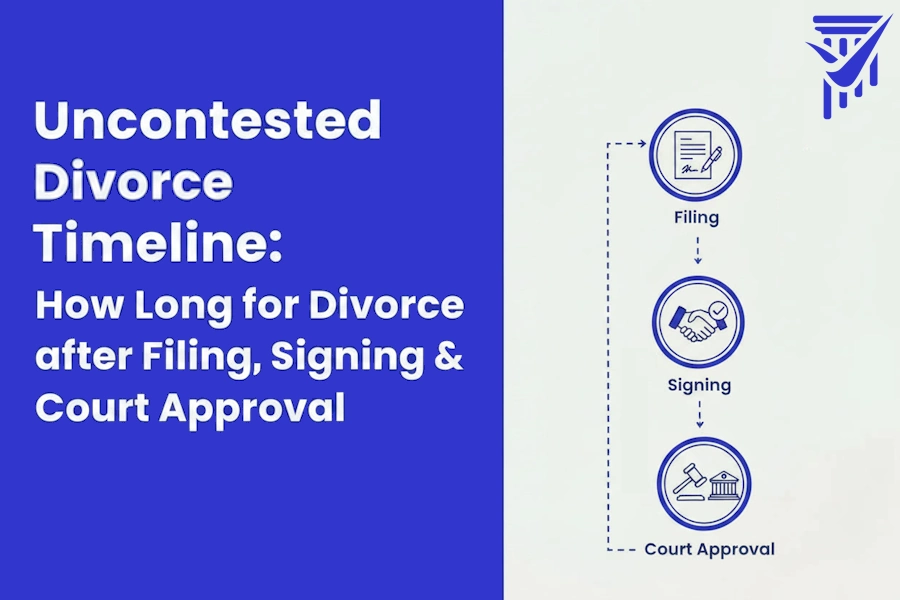
A quick answer is that a no-lawyer uncontested divorce in the US is completed within 2–6 months. Multiple factors can affect the exact timelines, the main of which are introduced below:
- The given state’s waiting periods.
- Court processing specifics.
- Paperwork accuracy.
- Service method and correctness.
- Spouse response.
- A possible need to review children’s support terms, financial issues, etc.
All papers can be prepared truly quickly. Thus, YourForms can help you complete filing within 2–3 days, but be ready for a longer finalization process in court. However, a contested case may take 12 to 18 months or even longer. For more insights into divorce timelines in US states, visit our blog.
Typical Timeline for an Uncontested Divorce
You’ll get divorced after you come through all the formalities. Observe the list of key points affecting divorce timelines:
- Document preparation.
- Filing with the court.
- Service of process.
- Respond period.
- Obligatory waiting period.
- Final forms filing.
- Court review or hearing.
- Final decree.
Roughly, it’ll take from 2 to 6 months, depending on the state and court. Correct filing and service, together with your spouse’s readiness to cooperate, are the factors that shorten your timeline.
Why Waiting Periods Still Apply Even When Both Spouses Agree
Another fact to accept is that fast filing and a complete agreement between spouses do not mean your marriage will be finalized instantly. Besides the in-court routine, you might have to deal with mandatory waiting periods. Their role is to give you and your spouse some time to think things over and possibly change the conditions (or even refuse to divorce altogether).
Waiting periods affect the finalization date. In California, it takes at least six months to complete a divorce. In Texas, only urgent cases with family violence can run quickly. A standard divorce takes 60 days or longer.
Delays Caused by Incorrect Forms, Missing Signatures, or Court Backlogs
Incomplete data or improper processing prolong divorce timelines. The most frequent delay triggers are:
- Wrong forms.
- Incorrect service.
- Missing signatures.
- Missing notarization.
- Faulty financial disclosures.
- Vague parenting/support terms.
- Court backlog.
Each correction may protract the proceedings for weeks, sometimes resulting in a 30–60-day delay.
How Better Preparation Can Reduce Avoidable Delays
Your path to a no-delay divorce process starts by properly organizing your documents. The rest can be securely prepared using YourForms. The tool provides state-specific forms in 2-3 days.
You’ll have to come through the required waiting periods and court schedules anyway, but better preparation may help you avoid delays caused by incorrect filing. Sign up with YourForms and get the right forms ready before filing, not after their rejection.
State Rules That Can Change How You File Without a Lawyer
Residency in a specific US state or county determines the rules for how to file for divorce without a lawyer. States and counties have their own requirements for:
- State/county residency rules.
- Court forms.
- Filing fees.
- Service rules.
- Waiting periods.
- Child support papers.
- Parenting classes.
- Final hearing.
Not to miss state- or county-specific rules, users should follow the exact filing instructions. To prepare the right uncontested divorce forms for your location quickly, visit YourForms instead of sorting out blank PDFs from other states.
How do states influence filing procedures? Let’s take a look at five of them to mark out the differences.
California: Child-Related Forms and a 6-Month Waiting Period
To successfully divorce in California, you should meet the state’s strict residency rules. This state also has rigid requirements for child support filing:
| Minimum state residency: | The last 6 months |
| Minimum county residence: | The last 3 months |
| Divorce waiting period: | At least 6 months |
| Child-related forms required: | Child custody, parenting times, child residence disclosure, child support plan |
If you’re planning a divorce with children in California, you cannot rely on generic forms from the Internet. You may cope with adequate document preparation by hiring a lawyer, using YourForms to create a proper filing package (for uncontested cases), or combining both options.
Texas: 60-Day Waiting Period and County Filing Differences
In Texas, filers should focus on the processing differences between counties. Each county may have its own rules for filing, issuance, and service fees. The prime rules include:
| Minimum state residency: | 6 months |
| Minimum county residency: | 3 months |
| Waiting period: | 60 days or longer |
| Fee waiver request: | Allowed/Processed according to the Statement of Inability to Afford Payment of Court Costs |
To correctly file in Texas, you should follow your county’s court instructions. Here, YourForms may be your perfect tool for preparing the right uncontested divorce forms for your county.
Florida: Parenting Course Requirements in Cases With Children
You may take Florida for a parenting-focused state with specific requirements for child support:
| Minimum state residency: | 6 months |
| Waiting period: | Absent |
| Parenting classes: | DCF-approved Parent Education and Family Stabilization courses, 4+ hours required |
| Child residency requirements: | Most courts require that minors have lived in Florida for at least 6 months, too |
In Florida, you should not ignore county specifics, either. So, opting for YourForms to prepare the right county-aware paperwork is a sound solution. If it’s a divorce with children, prepare yourself for parenting classes, which are sure to add cost and extra time before finalizing.
New York: Extra Forms for Divorces Involving Children
Plan a divorce in New York? Pay attention to this jurisdiction’s required forms for child support.
In fact, a child’s paperwork packet and a no-children one are assembled differently here, and you must not interchange them.
| Minimum state residency: | 2 years (or 1 year, provided your marriage was contracted in NY, you have lived as a couple in NY, or your divorce reason roots in NY) |
| Waiting period: | 30 days or longer |
| Child-specific forms: | Addendum to RJI Form 840M; UCS-111 Child Support Summary Form |
| Other forms used: | Summons and Complaint, Summons with Notice, Affidavit of defendant |
NY court practices differ from those of other US states. Your case may require (or allow you to use) special forms, which you can safely prepare using the YourForms online service.
Colorado: Residency Rules for Parents and Children
Colorado stands out with its genuine child residency logic. The state allows for several filing methods as well:
| Minimum residency requirements: | 91 days |
| Child residency requirements: | 182 days since birth or longer |
| Filing methods: | Joint, Separate, Online |
| Specific options: | Waiver of service |
What other Colorado rules should you know before filing? Complete the YourForms questionnaire today to prepare the correct paperwork for your uncontested divorce without a lawyer in this state within 2-3 days.
Why Your County Court Instructions Matter as Much as State Law
While your state imposes the major rules, your county defines how the nuances and separate procedures should be implemented. It’s a county court that affects the choice of filing and service methods, court forms, hearing schedules, and e-filing.
A big mistake is to copy the rules set by another county or state. Following the exact local court instructions helps filers avoid errors, especially when they use YourForms to properly prepare state-bound forms.
Filing Without a Lawyer When You Have Children
Are you prone to a popular misconception that a no-lawyer divorce is not for those with kids? You can get divorced without a lawyer, even with children, if you ensure the following:
- Your process remains uncontested.
- There’s agreement on child custody, support, and other conditions.
- You’re ready to provide the required court forms in your state/county.
- You’ll get parenting classes if necessary.
- Your paperwork is capable of the final review.
The key point here is form complexity – you have to file all the required papers in the correct form. To learn more about custody and other terms, visit our page dedicated to divorces with children. YourForms can help to prepare the state-required forms if the case is purely uncontested. However, the court makes decisions, so you need to follow the local instructions carefully.
Why Children Do Not Automatically Make a Divorce Contested
Not minors, but their parents’ disagreement makes an uncontested divorce without a lawyer contested and requiring extensive legal help. To keep your process uncontested, it’s essential to agree on all terms with your spouse:
- Custody.
- Parenting time.
- Child support.
- Health insurance.
- Transportation & holidays.
- School scheduling, etc.
This list only indicates that your process will require more court-filing forms, even in an uncontested divorce. However, the court may review the child-support measures, so correct filing is your first priority.
If you’re wondering how the process affects kids emotionally, our guide to the effects of divorce on children can help you prepare them for the transition.
Custody, Parenting Time, and Child Support Documents
What do parents need to agree on to make an uncontested divorce possible? Let’s clarify the main child-related terms you’ll have to understand:
- Custody determines the main aspects of your child’s life after the breakup. Here, you set rules for their healthcare, education, visits, phone calls, vacations, and other arrangements.
- Child Support Worksheet (Summary) describes the financial and parenting aspects. Courts tend to review the fairness and legality of these arrangements, even if both parents agree. Expect special guidelines for expenses related to medical care, health insurance, and similar costs.
- Health Insurance states who covers the costs, how non-standard medical expenses will be divided, how parents should share insurance info, and other rules for important procedures related to the child’s health.
- The Parenting Plan fixes the key responsibilities of each parent. It explains where the kid will live, spend their holidays, and so on. A common appendix to the parenting plan is the Expense Sharing form, in which additional expenses, such as vacation and education costs, are budgeted.
- Decision-making Terms prescribe how important decisions must be made and define each parent’s role in them.
- Residence History & Custody Disclosure is required in some jurisdictions that impose strict residency rules for minors (e.g., Florida and Colorado). These forms reveal the kid’s name, date of birth, current address, and other details.
All these terms should be properly documented using the exact forms accepted in your local court. In this respect, YourForms, with its detailed questionnaire and guided forms, can simplify the task.
If the family home is part of your settlement, our guide to the house in a divorce with children walks through the most common approaches.
Parenting Classes and Local Court Requirements
In many states and counties, parenting education is an obligatory part of the divorce process with minors. Thus, in Florida, you’ll have to complete 4-hour courses. Other counties may require educational seminars, mediation, and similar measures. Before you file, make sure to check your local court’s instructions in this respect.
Talking to your kids about the process matters just as much as the paperwork. Our guide on how to tell kids about divorce offers practical, age-appropriate ways to break the news.
When Child-Related Disagreements Require Legal Help
An online uncontested divorce without a lawyer is available even with children. If there’s complete agreement between you and your spouse, and all your documents are organized, YourForms may help you to quickly file with the court.
Any disputes or ambiguities present? Then, online DIY divorce is not the best option. You might need legal advice on frictions related to:
- Custody.
- Decision-making.
- Relocation.
- Child support.
- Safety concerns.
- Access withholds.
- Healthcare & education.
Online forms are useful for well-arranged cases. They won’t help you solve custody disputes!
Common DIY Divorce Mistakes That Can Delay Your Case
How not to turn a simple process into a long-term disaster? Let’s analyze the most common mistakes online filers commit:
| Error: | Consequences: |
| Filing in the wrong county | Rejection, transfer, & forced refilling |
| Filing the wrong forms | Delay & possible refiling |
| Missing signatures/notarization | Immediate rejection & forced refilling, contested status as the worst aftermath |
| Required disclosures absent | Delays, possible sanctions & fines, contested status as the worst aftermath |
| Equate the documents filed to the final approval | Neglecting the rules and proceedings may cause delays and dismissals |
You shouldn’t be afraid of DIY filing, but you do need to take all the proceedings seriously. Each correction step may take 30–60 days and incur additional expenses. So, filing for an uncontested divorce without a lawyer correctly is your first-priority mission.
There are no legal guarantees even in simplistic cases, especially when the essentials are missed or neglected. To lower the risks, use YourForms state-based forms and guidelines, but combine the tool with your own carefulness to details and patience.
Filing in the Wrong County or Before Meeting Residency Rules
If you have filed in the wrong county, your case can be moved to the correct one, but the process takes time. Another possible consequence is that your papers are rejected, and you have to refile.
One more mistake is to file too early and violate your state’s residency requirements. This happens when neither you nor your spouse has lived in the state enough to file (91 days in Colorado, 6 months in Florida and California, etc.) Then, your case will be delayed until the rules are fully met.
Using the Wrong Forms or Outdated Court Documents
Mind that court filing forms differ by state and county. They’re updated from time to time. You should pick forms for child custody, property, fee waivers, service, etc., in compliance with the local court instructions.
Wrong forms may cause rejection. A practical solution here is to assemble the correct divorce papers using YourForms. However, you must be precise and honest when completing the questionnaire.
Missing Signatures, Notarization, or Required Attachments
Signatures and notary procedures are important nuances determined by local counties. They define:
- Whether you or your spouse should sign this or that document.
- If notarization is required for your fee waiver, proof of service, etc.
- If any attachments are needed, etc.
- If digital signature & notary are accepted.
At YourForms, you can request an E-Signature for $0.90 per paper. The service enables online notarizations with a $29 setup fee, plus $20 per form in a single session or $30 per form in a mutual session. However, opt for all of this while filing for your uncontested divorce without a lawyer, if it’s allowed in your county, to avoid rejection.
Skipping Financial Disclosures or Child-Related Forms
No-lawyer filing online remains a legal process. If its requirements are ignored, the approval will be dismissed. Even in an uncontested divorce, you should provide all necessary disclosures and be prepared for court review. Do not neglect financial and child support forms to avoid unnecessary complications!
Assuming Online Filing Means the Court Has Approved the Divorce
The key takeaway: you may use e-filing as a time-saving tool to help assemble the right paperwork. Nevertheless, online filing tools don’t make decisions and never perform the roles of courts and judges.
So, to move to the final divorce approval, you’ll have to complete waiting periods, participate in hearings where required, etc. Ignoring this may lead to unfavorable decisions from the judge.
When Filing Without a Lawyer Can Cost More Later
Can you get divorced without a lawyer and extra costs at later stages? The answer may be negative when it comes to:
- Hidden assets.
- Support & retirement account issues.
- Business interests.
- Complex property.
- Child support disagreements.
- Domestic abuse.
- Coercion.
- The spouse already has a lawyer.
Yes, a DIY divorce may be the cheapest variant for you, but do not go too far by violating the laws! The main goal is to make the process affordable and fair.
YourForms is your trusted tool for preparing state-approved divorce papers, but it’ll pass if your case is uncontested and has no hidden subjects to disputes. Otherwise, later corrections and extra expenses are highly possible.
Hidden Assets, Business Ownership, or Retirement Accounts
Complex financial circumstances usually involve legal advice. Divorces involving business agreements may require assessment, while retirement accounts may require legal review and special orders. For instance, in Texas, QDRO forms aren’t provided, and you might need a lawyer to draft or review the terms.
When filing an uncontested divorce without a lawyer and with hidden assets, filers may face a fraud suit, criminal charges, and severe reputational consequences. Online divorce won’t guarantee them a “clean getaway.”
Domestic Abuse, Coercion, or Power Imbalance
A DIY divorce is not a safe plan for cases with domestic abuse issues, coercion, or power disparity. If you’re divorcing while feeling unsafe or pressured, you might need to start with local legal aid and consider contacting emergency services or directly the local attorney.
Starting with YourForms can be ineffective in such a case, as you’ll have to settle the service procedure, custody, and housing terms in court.
When Your Spouse Already Has a Lawyer
Since your spouse already has a lawyer, you may use online tools for document preparation. Still, requesting a legal review is an appropriate strategy that may prevent you from agreeing to disadvantageous terms. This is especially true for cases with property, retirement, support, custody, or settlement terms.
Agreements That Look Simple but Create Long-Term Problems
Does an uncosted divorce always mean an easy approval? No, and you shouldn’t be overoptimistic about a case with untransparent, unrealistic conditions for:
- Property division.
- Debt responsibilities.
- Child support.
- Retirement accounts division.
- Spousal support.
- Missing taxes.
Terms achieved under pressure, based on verbal promises, or documented without proper legal review, may quickly switch your case into a trouble-making one. YourForms may provide the correct forms, but their unclear refilling won’t help you in court.
How YourForms Helps With Divorce Without a Lawyer
In your uncontested divorce without a lawyer, are there no vague points, and are all the divorce papers organized? YourForms may ensure a more structured filing process without endlessly investigating blank court PDFs. The online service helps prepare the appropriate forms for the given state/county and provides filing instructions. At present, the available YourForms services include:
| YourForms options: | Details: |
| Starting price | $69/month |
| Ready-to-file package | Within 2-3 days (for well-organized documents) |
| Are Children/Property cases accepted? | Yes, uncontested divorce only |
| Add-ons | Court Filing Service ($199–$399).E-Signature ($0.90/paper).Online notarization ($29 setup + $20 or $30/form).Document Delivery ($29–$49). |
YourForms doesn’t consult users on legal issues. It simplifies filing, but it doesn’t guarantee court approval and may not replace the attorney if required.
If your divorce is uncontested and has no missing points, sign up with YourForms. We’ll guide you through the entire filing process and ensure the required forms, delivery options, digital signature, and more.
Curious what other filers experienced? Read verified YourForms reviews before you start your questionnaire.
State-Specific Divorce Forms Based on Your Answers
Filing with YourForms starts with a questionnaire that covers key details of your case. Your accuracy and honesty matter when answering, as the tool assembles state-specific document packages based on the information provided.
Expect questions about children, property, debts, and related matters. You’ll need to indicate your county, your spouse’s location, and other essential details. Start your questionnaire today, and you’ll get the required forms for your case without hours of manual search.
Filing Instructions Written for Uncontested Divorce Cases
YourForms is designed for smooth interaction throughout the filing process, although no legal advice or judicial services are offered. It provides clear instructions and helps users understand what to do with the prepared forms. You can file for an uncontested divorce by completing one step after another with confidence.
Optional E-Signature, Online Notarization, Delivery, and Filing Support
YourForms add-ons can make the filing process even more convenient. The available services include:
- E-Signature: Sign papers at $0.90 per document.
- Online notarization: Set up at $29, plus $20 for a single session & $30 for a mutual session per form.
- Document Delivery: Mail printed & completed forms in the US at $29 (USPS regular, 6–11 business days) or $49 (FedEx express, 1–4 business days).
- Court Filing Service: Request premium support, document review, correction, and e-filing at $199–$399 (for select locations only).
You should check each add-on’s availability for your state and county. Your case may also matter.
What YourForms Does Not Replace
What services will you not find with the online tool? Being a self-help platform for divorce filing, YourForms does not:
- operate as a law firm;
- provide any legal advice;
- represent anyone in court;
- decide on custody, property division, support, etc.
YourForms doesn’t replace a lawyer if your case actually needs their help. Using this tool doesn’t guarantee success in court, and users are responsible for court fees, deadlines, signatures, and other judicial proceedings.
Learn more about our mission and team on the About Us page.
Final Checklist Before You File for Divorce Without a Lawyer
The starting point is to clearly understand how to file for divorce without a lawyer and ensure your case is uncontested. Then, you check the details, such as residency, venue, etc., and prepare the necessary forms. You need to fill out child or financial forms if your case requires them. It’s up to you to decide if legal review is a safer mode for you.
Want to streamline the filing process? Use YourForms to quickly assemble the correct document package by state/county, but plan service properly and understand the court filing fees. Be ready for waiting periods, hearings, and other formalities.
Still have questions about a specific step? Visit our Help Center for additional guidance.
Confirm Your Case Is Uncontested
It’s crucial to correctly identify your case. You’re going to run an uncontested divorce if:
- You and your spouse agree to divorce.
- Both of you agree on property, children, support, debts, and related matters.
- Your spouse’s location is known.
- There are no safety concerns or pressure.
- No hidden assets.
Are any of these points not matched? Then, you might need to request a legal review of your papers.
Check Residency, Venue, Forms, Fees, and Service Rules
As soon as your case is uncontested, you may proceed with filing. Here are the steps to take:
- Confirm the family court to file.
- Make sure your spouse or you’ve lived enough in the state and county to file.
- Prepare proper state/county forms.
- Check the filing fee and the availability of a fee waiver.
- Choose a service method supported.
- Understand the waiting period.
- Check if children support or another speciality requires extra forms, parenting classes, etc.
Have any doubts? Consider seeking legal advice – it’s better to prepare everything thoroughly at the very beginning than to face delays, corrections, and extra fees later.
Review All Documents Before Filing
Minimise the risk of rejection by reviewing the document package. Check thoroughly:
- County, names, dates, addresses.
- Terms for children, support, debts, property, etc.
- Signatures.
- Notarization, where required.
- Attachments, where needed.
- Final decree terms (before letting the spouse sign it).
Whether you file through YourForms or to the clerk, keep copies of everything filed.
Know When to Pause and Ask for Legal Help
Understanding how to file for divorce without a lawyer includes knowing when to hold up. Be realistic while measuring the risks. Make sure to request legal help early. You might need to pause filing if:
- Your spouse disagrees with the terms.
- Your spouse has a legal representative.
- There are safety concerns.
- There are hidden assets.
- The agreement affects business ownership, house buyout, retirement, or long-term support.
If there’s no reason to pause, and your case is fully uncontested, you might need guided forms for your state and county.
Sign up at YourForms to get state-specific divorce papers online and extra filing support if necessary.